Another from Richard Aldridge:

Moth at My Window

Against my pane
He beats a rapid
Pitapat
In trying to reach
The desk lamp lit
In front of me.
Wing flurries spent,
He crawls and toils
This way and that,
His whole self bound
To pierce the veil
He cannot see.

The glance I turn
On him, light
Spreading still across
My page, is one
Of interest in
The company.
Whatever time
I take to watch
Will be no loss
From my own toils
To pierce the veil
I cannot see.

(And this I think should be friends with Aracelis Girmay’s “Consider the Hands that Write this Letter.”)

“hypocrisy is just a mismatch”

Ross McCullough:

Sr. Perpetua,

Your note reminds me of the story about the old cardinal and patristics scholar who died in the house of a prostitute, with a large sum of money in his wallet. Everybody said he was a saintly man, and here he is discovered in a particular indelicacy. The defense came quickly: he had a ministry to the outcast; he often brought them money; and after all he was discovered clothed on a sofa, hardly disreputable.

Was he there for her body or her soul? What an exact ambiguity for the Church! So easy to accuse him of corruption; so easy to think he is a martyr falsely accused. Did he himself know entirely why he was there?

The world laughed at him for visiting her for her body, but it would have vilified him for importuning her soul. To pay her for sex would have been mere hypocrisy on his part and gainful employment on hers; to make her hate herself would have been damnation for them both—damnation in a world without hell, to be sure, but still damnation.

And perhaps he was a hypocrite. Can we really know? But even hypocrisy has a direction: Was he a good cardinal falling into fornication or a fornicator rising into his cardinalate? Hypocrisy is just a mismatch, and any change that is not immediate and total will produce mismatches—changes for worse and changes for better.

Are we to be a Church without hypocrisy, then, or are we to be a Church whose hypocrisy runs in the right direction? I sometimes feel as if the only progress lies in throwing a line too far forward and then dragging ourselves up by it as best we can. For some deep reason, that is more effective than methodically constructing the virtues like a mason or a geometer. This is the great mystery of vows—clerical, monastic, marital—and it is why their centrality in our lives should not be neglected? It is impossible to advance if you have to fight your way step-by-step into the uplands; you must commit yourself by great leaps and let your failures be here and there lapses in your commitments. Claim the city whole, do not take it house by house; make your vices fight you slowly back for it.

But the field will never be swept clean, and we should hold on to such men as the cardinal.

poem pals

It’s not a bad time-filling activity to be flipping pages looking for a poem. Not necessarily a specific poem; not necessarily a specific topic. Just quietly eyeing pages like you might eye the shelves of your pantry or refrigerator for a snack. Sometimes you find a poem that you think should be friends with another poem. Like last month, finding Gary Lawless’s “Some Clear Night” and thinking it should be friends with Merwin’s “For the Anniversary of My Death.” (Maybe they are already friends.)

Here’s another. I was rereading some Richard Wilbur this morning, and I think his poem “Man Running” ought to be good friends with Les Murray’s “An Absolutely Ordinary Rainbow.”

(Maybe they are already friends.)

Richmond, Virginia, 1865. Source.

From an interview with Dr. Nelson D. Lankford:

What surprised you the most in the process of writing your book? 

I supposed the greatest surprise I encountered, other than the pervasive sense of uncertainty, was the sweep of characters who populated the postwar city. They truly constituted an amazing kaleidoscope of personalities, all grappling with their altered circumstances in their different ways. A minority of white Unionists forging a new polity amid the ruins of the old, the former Confederates who opposed them because they could not envision a new Virginia, Black entrepreneurs building new businesses, industrialists trying to revive their shattered fortunes—they all played their roles in the Richmond that arose from the devastation and loss of total war.

What’s your favorite anecdote from your book?

My favorite anecdote is about Garland White, a chaplain with a Black Union regiment that entered Richmond on April 3, 1865, the day of Confederate collapse. White had been born into slavery in Virginia but as a child escaped to the North. When freed people crowded around his regiment to welcome their liberation, an old woman bend with age and toil quizzed White. When he answered her queries to her satisfaction, she told the startled chaplain she was his mother. A true story!

Garland White’s account of that reunion:

“What is your name, sir?”
“My name is Garland H. White.”
“What was your mother’s name?”
“Nancy.”
“Where was you born?”
“In Hanover County, in this State.”
“Where was you sold from?”
“From this city.”
“What was the name of the man who bought you?”
“Robert Toombs.”
“Where did he live?”
“In the State of Georgia.”
“Where did you leave him?”
“At Washington.”
“Where did you go then?”
“To Canada.”
“Where do you live now?”
“In Ohio.”
“This is your mother, Garland, whom you are now talking to, who has spent twenty years of grief about her son.”
I cannot express the joy I felt at this happy meeting of my mother and other friends.


White, Garland H. Letter to the Christian Recorderdated April 12, 1865. Published in the Christian Recorder, April 22, 1865

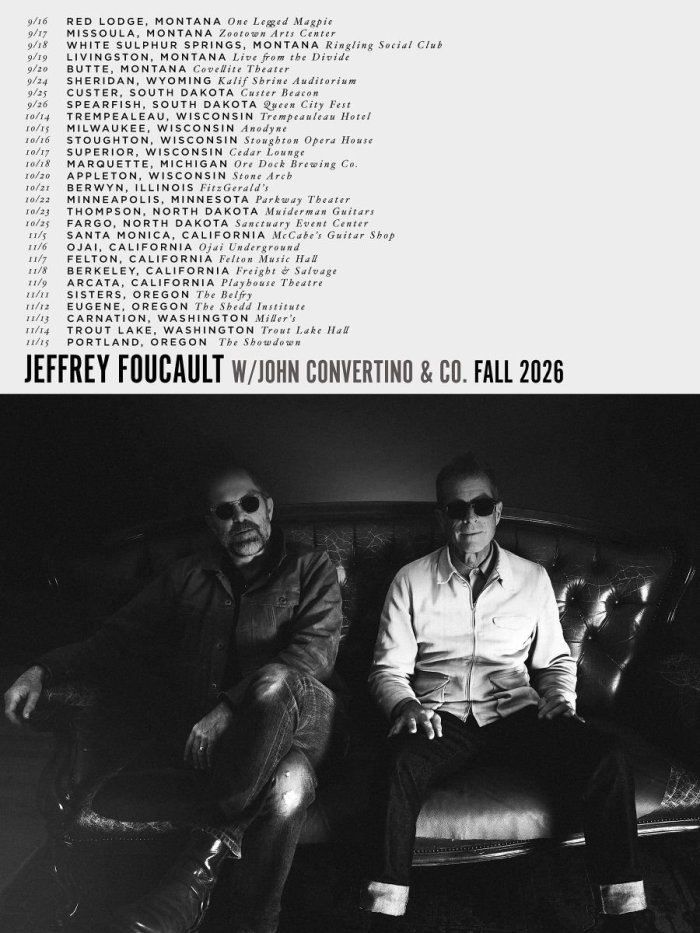
Jeffrey Foucault in his latest newsletter:

I spoke long letters into my phone, edited them in little cafés over greasy tacos and black coffee, worked on them for days in a row, and deleted them. When I was younger I believed there must be some magic combination of words, some alchemical arrangement which if discovered could locate a clarity wholly fugitive otherwise. I don’t believe that anymore. Or rather, I believe that clarity is possible but its survival between human beings is rare, and words are at best a form of translation. Most of what we would say isn’t sayable, and what we do say doesn’t help all that much. I still like to write letters though.

Jorge Luis Borges, in the foreword to his 1969 “In Praise of Darkness”:

Poetry is no less mysterious than the other elements of the orb. A lucky line here and there should not make us think any higher of ourselves, for such lines are the gift of Chance or the Spirit; only the errors are our own. I hope the reader may find in my pages something that merits being remembered; in this world, beauty is so common.

“a prison gets to be a friend”

John Gray:

Technological progress has brought into being a system of surveillance more far-reaching than any Bentham could have conceived.

Enclosing the entire population in a virtual Panopticon might seem the ultimate invasion of freedom. But universal confinement need not be experienced as a privation. If they know nothing else, most are likely to accept it as normal. If the technology through which surveillance operates also provides continuous entertainment, they may soon find any other way of living intolerable.

Alongside the system of surveillance there is a world of media images in which terror and entertainment are intermingled. Seemingly safer than the world outside and more stimulating than unmediated everyday life, this virtual environment resembles the settings of reality television more than it does a prison. A feature of reality shows is that the inmates have nothing to do. Aside from overcoming cleverly staged challenges and interacting emotionally with one another, they are completely idle. It may not be too far-fetched to see in their condition an intimation of the future for the majority of people. If the advance of smart machines leaves most human beings an economic role only as consumers, this may be how they will be expected to pass their time.

One of the strengths of such a universal Panopticon is that the perils against which it protects are not all imaginary. The atrocity exhibitions that are on display in the media are not just fantasies. The most savage wars rage unabated; random violence can happen anywhere at any time. With the rapid evolution of techniques of cyber-attack, every modern amenity is vulnerable to sudden disruption. To assume that the inmates yearn to escape the universal Panopticon would be rash. Their worst fear may be of being forced to leave.

Cf. Dickinson: “A prison gets to be a friend…”

See also Nicholas Carr (sort of):

We’re still attracted to a flame at the end of a wick. We light candles to set a romantic or a calming mood, to mark a special occasion. We buy ornamental lamps that are crafted to look like candles or candleholders, with bulbs shaped as stylized flames. But we can no longer know what it was like when fire was the source of all light. The number of people who remember life before the arrival of Edison’s bulb has dwindled to just a few, and when they go they’ll take with them all remaining memory of that earlier, pre-electric world. The same will happen, sometime toward the end of this century, with the memory of the world that existed before the computer and the Internet became commonplace. We’ll be the ones who bear it away.

All technological change is generational change. The full power and consequence of a new technology are unleashed only when those who have grown up with it become adults and begin to push their outdated parents to the margins. As the older generations die, they take with them their knowledge of what was lost when the new technology arrived. Only the sense of what was gained remains.

The caveat that I’ll add (to Carr, not to Gray; with Gray you get no sweetener or chaser) is something from the margins of the last issue of Local Culture. Adam Smith’s piece in it, “The Work of Liesure: An Essay on Jacob Snyder’s Leisure,” is excellent. I’m not going to capture the smarts in Smith’s piece here, but he argues that it’s only because of our laziness and condescension toward the past that we have such a hard time imagining how they did great things. “We find it easier to believe that aliens built the pyramids than to believe that people just like us could build pyramids without bulldozers.”

A healthier attitude, he argues, would respect the craft — or, crafts — and see in the past a “memory of skilled activity.” But his real point is that this skilled activity also applies to leisure. “If people in the past knew how to work in ways that we’ve forgotten,” he writes, “maybe people in the past also knew how to not work in ways that are lost on us.”

While much of our work is not intrinsically valuable, most of us have at least some tangible experience of work that is its own reward, and that gives us a handle on the idea that our problem is not too much work but too little good work. By contrast, few of us have any experience of good leisure. We all know how to take a break, to be entertained, to practice “self-care.” Most of us have no clue how to “take our leisure.” You might as well ask us to build a pyramid without a bulldozer.

As I said, it’s an excellent piece. But I wonder if he takes the argument too far. At one point Smith suggests that good leisure “is a much more fragile achievement than good work, and it is subject to more permanent loss when the know-how disappears.” My caveat-in-the-margins is that, though it might be more fragile in some ways, I suspect leisure — and the “expansion of being” good leisure brings — is more innate than the collective knowledge of craft, and therefore less subject to permanent loss.

Ditto for Carr. It is not difficult for me to imagine those who were never limited to the wick and flame being more enchanted by it than those who were and have no desire to go back. This technology has not only ruined the young, not by a long shot. There are plenty of Boomers who I sadly but honestly consider a lost cause in this regard. (I suspect it has something to do with trajectories: the young were not subject to the optimism and momentum of “Western development.” Gray: “Nothing is more alien to the spirit of the age than to suggest that anyone might seek inner freedom, for it suggests doubt as to the prevailing faith that the human world is improving. Clearly, there are many who cannot do without this comforting faith. The most charitable course is to leave them to their slumbers.”)

But the main point is simply this: candle wicks and walking sticks are still not just available but abundantly available, right now.

Open your eyes. Or: lift your head and extend your elbows.

Dickinson:

To be alive—is Power—
Existence—in itself—
Without a further function—
Omnipotence—Enough—

To be alive—and Will!
‘Tis able as a God—
The Maker—of Ourselves—be what—
Such being Finitude!

Technology has not, no matter what the flip they tell you, eclipsed anything. “As soon impeach my Crown!,” writes Dickinson in a slightly different context. The world and the wisdom and the wicks and the sticks and the damn good leisure are still right there waiting.

In other words, Gray’s warning applies and it applies harshly — but in a very real sense, pace Carr, it applies equally to anyone. And therefore it can be heeded equally by anyone.

It may be too late for the Boomers. But for all my deep ‘n dark pessimism about what humans will do, I remain fairly committed to the idea that we can, anytime we like, escape the machine. Your phone isn’t heroin or alcohol to your body, and an electronics-free walk into the woods or just away from home carries its own dopaminergic reward — an eminently, imminently, infinitely discoverable reward.

I was not intending anything past the Gray quote, so these are just rough notes. But while I’m thinking of it, there are two nearly contradictory visions I have of all this. One of them is not unlike that scene at the end of V for Vendetta, but instead of the mass removal of Guy Fawkes masks it would be a mass hurling of “devices” into a molten abyss.

The other is that moment Merwin describes when “after three days of rain / Hearing the wren sing and the falling cease.” Except that it is not death being described but life.

The second one does not require a mass movement; an individual whimsical mood can suffice. But the mass movement would be nice, wouldn’t it?

“governing” apprentice sorcerers

Frank Kendall, former Secretary of the Air Force:

The tool Anthropic is providing to the government is enormously powerful; like other tools, it can inherently be used for good or evil. Anthropic is rightly concerned that its tool could be used in ways that are unsafe or malicious. The company doesn’t want to see its A.I. model used without human control, which could result in the killing of noncombatants or friendly troops by automated weapons, nor deployed to spy broadly on Americans in ways that could violate dearly held values like privacy and freedom from illegal search and seizure or could suppress political dissent. Most Americans would probably agree.

Aww. So very cute; so utterly stupid.

Jean-Pierre Dupuy:

How, then, do we account for the fact that science has become so risky an enterprise that some of the world’s most distinguished scientists consider it to constitute the chief threat to the survival of humanity? This question must now be regarded as taking precedence above all others. Many philosophers reply to it by saying that Descartes’s dream—of putting man in the place of God, as the master and possessor of nature— turned into a nightmare, with the result that mastery is now itself in urgent need of being mastered. I fear that they have not the least understanding of what is really at issue. They fail to see that the technology now taking shape at the intersection of a great many fields aims precisely at non-mastery. I repeat: the engineer of tomorrow will be an apprentice sorcerer not by negligence or incompetence; he will be one deliberately. He will begin by imagining and designing complex organisms in the form of mathematical models, and will then try to determine, by systematically exploring the landscape of their functional properties, which behaviors they are capable of supporting. In adopting a “bottom-up” approach of this kind, he will be more an explorer and an experimenter than a builder; his success will be measured more by the extent to which these creatures surprise him than by their agreement with a set of preestablished criteria and specifications. Fields such as artificial life, genetic algorithms, robotics, and distributed artificial intelligence already display this character. In the years ahead the aspiration to non-mastery threatens to reach fruition with the demiurgic manipulation of matter on the atomic and molecular scale by nanotechnologies. Moreover, to the extent that the scientist is now likelier to be someone who, rather than seeking to discover a reality independent of the mind, investigates instead the properties of his own inventions (more as a researcher in artificial intelligence, one might say, than as a neurophysiologist), the roles of engineer and scientist will come to be confused and, ultimately, conflated with each other. Nature itself will become what humans have made of it, by unleashing in it processes over which, by design, there is no mastery.

(Dupuy’s book was originally published in French in 2008; English in 2013.)

truly ambivalent; truly engaged—i.e. human & whole

From Ross McCullough’s fictional “Letters from the Last Archbishop of Lancaster”:

Fr. Rodrigues,

… Your instincts are right that the Church must always remain in some way in the opposition; but she must also be in the opposition to the opposition, if that makes sense.

Even with all that has happened in the long train from Christendom to whatever bastard elopement of Islam and spiritualism and liberalism we have now, whatever tangle of heresy with heresy with heresy our metamodernity is, we should not expect one party to have a monopoly on the truth. Indeed, the more ambient and confused the heresies, the harder it is for one side to better the other in every significant respect. There is no Pareto optimality between the parties: to side with one is always to give up something important. It is even to give up some incommensurable good whose loss is not balanced out or outweighed by the other side; it is just lost. Our ambivalence need not be perfectly equipoised, then, but it must be truly ambivalent. And our engagement should not suffer for it: we cannot ignore the ways that the political forms us. You must share a city with these people but not a City, if that helps. (I realize in many respects it doesn’t.)

The doctrine of analogy is that “between Creator and creature no similitude can be expressed without implying an even greater dissimilitude,” and our politics is analogous in that sense too. Between the kingdom and the nations, every alignment implies an even greater misalignment. We cannot side with some secular party without implying, in how we side with them, an even greater opposition- and the closer we side with them, the stronger the implication must be.

C.S. Lewis:

The Innovator attacks traditional values (the Tao) in defence of what he at first supposes to be (in some special sense) ‘rational’ or “biological’ values. But as we have seen, all the values which he uses in attacking the Tao, and even claims to be substituting for it, are themselves derived from the Tao. … The question therefore arises what title he has to select bits of it for acceptance and to reject others. For if the bits he rejects have no authority, neither have those he retains: if what he retains is valid, what he rejects is equally valid too.

But then, in every form of the Tao which has come down to us, side by side with the duty to children and descendants lies the duty to parents and ancestors. By what right do we reject one and accept the other? Again, the Innovator may place economic value first. To get people fed and clothed is the great end, and in pursuit of it scruples about justice and good faith may be set aside. The Tao of course agrees with him about the importance of getting the people fed and clothed. Unless the Innovator were himself using the Tao he could never have learned of such a duty. But side by side with it in the Tao lie those duties of justice and good faith which he is ready to debunk. What is his warrant? He may be a Jingoist, a Racialist, an extreme nationalist, who maintains that the advancement of his own people is the object to which all else ought to yield. But no kind of factual observation and no appeal to instinct will give him a ground for this opinion. Once more, he is in fact deriving it from the Tao: a duty to our own kin, because they are our own kin, is a part of traditional morality. But side by side with it in the Tao, and limiting it, lie the inflexible demands of justice, and the rule that, in the long run, all men are our brothers. Whence comes the Innovator’s authority to pick and choose?

from “Waking Early Sunday Morning”

No weekends for the gods now. Wars
flicker, earth licks its open sores,
fresh breakage, fresh promotions, chance
assassinations, no advance.
Only man thinning out his own kind
sounds through the Sabbath noon, the blind
swipe of the pruner and his knife
busy about the tree of life…

Pity the planet, all joy gone
from this sweet volcanic cone;
peace to our children when they fall
in small war on the heels of small
war—until the end of time
to police the earth, a ghost
orbiting forever lost
in our monotonous sublime.

— Robert Lowell

*This is not to be read as signaling a position on some side of that ever-insistent partisan line, nor does it allude to an Opinion; I’m just sitting in a boat, looking and listening for descriptions of the waves. And I suppose it’s not a coincidence that Hölderlin’s boat in that link was already connected to Iran, and to a 15-minute-video everyone should watch.

I love it when a poem is just fun, and no less deep for being so.

The Red and Green Cement Truck

rumbles by to where it’s going, while
     at an incline on the bed and
at right angles to the wheels
         its mixer, shaped
     like a big cocktail shaker, turns
upon an axis slowly, slowly,
     blending the cement and water.

     It is a feat as neat as
pat-your-head-and-rub-your-belly
     but what I like still better is
           to see in it
     ourselves, we who do best
to use our heads for mulling, mixing
       while with our feet
          we keep on trucking.

Richard Aldridge